


The number five composed of butterflies for the Claude Fable 5 launch

Anthropic model guide

Claude Fable 5 for complex reasoning and long-horizon work

Claude Fable 5 is Anthropic’s most capable widely released model. Introduced on June 9, 2026, it is built for difficult software engineering, sustained analysis, visual reasoning, scientific research, and autonomous work that may span many steps. This guide explains what the model does, where its benchmark gains matter, and what to consider before using it.

1M-token context window128K-token maximum output$10 input and $50 output per million tokens
Open AI chat

What is Claude Fable 5?

Claude Fable 5 is a Mythos-class model made available with additional safeguards for general use. Anthropic describes it as its most capable widely released Claude model. It is designed for assignments where the model must inspect substantial information, plan several stages, use tools, check intermediate results, and remain aligned with the original objective.

The Fable 5 model is particularly relevant to codebase migrations, repository-scale debugging, document research, financial analysis, spreadsheet work, scientific reasoning, and visual tasks. Anthropic reports that its advantage becomes more pronounced as tasks become longer and more complex.

Its one-million-token context window supports outputs up to 128,000 tokens. A larger context does not automatically produce a better answer. Users still need to supply relevant files, define the outcome, identify constraints, and request verification. The large window is most useful for a substantial codebase, a collection of contracts, or a long research record.

Released
June 9, 2026
Context window
1M tokens
Maximum output
128K tokens
API input
$10 / million tokens
API output
$50 / million tokens

Core Claude Fable 5 capabilities

The model combines stronger reasoning with vision, tool use, and long-context performance. These capabilities are most useful when they support a defined workflow rather than an isolated prompt.

Agentic software engineering

The model can inspect repositories, plan changes across files, implement code, run tools, and revise its approach after failures. Anthropic reports strong SWE-Bench Pro and Terminal-Bench 2.1 results. Teams should still require version control, tests, review gates, and restricted credentials.
Long-horizon reasoning

The Fable 5 model is intended to remain focused through many actions and a large body of context. It can use notes and intermediate artifacts to improve later decisions in investigations, migrations, and research plans.

Knowledge and document work

It can compare documents, interpret charts and tables, identify contradictions, and explain the evidence behind a conclusion. Anthropic highlights finance, legal analysis, and professional knowledge work. High-stakes decisions still require source checking and qualified review.

Vision and interface understanding

The model can reason over screenshots, diagrams, scientific figures, and charts. Anthropic reports improved extraction from complex figures and reconstruction of web interfaces from screenshots. Clear images and explicit questions help separate observation from inference.

Claude Fable 5 benchmark results

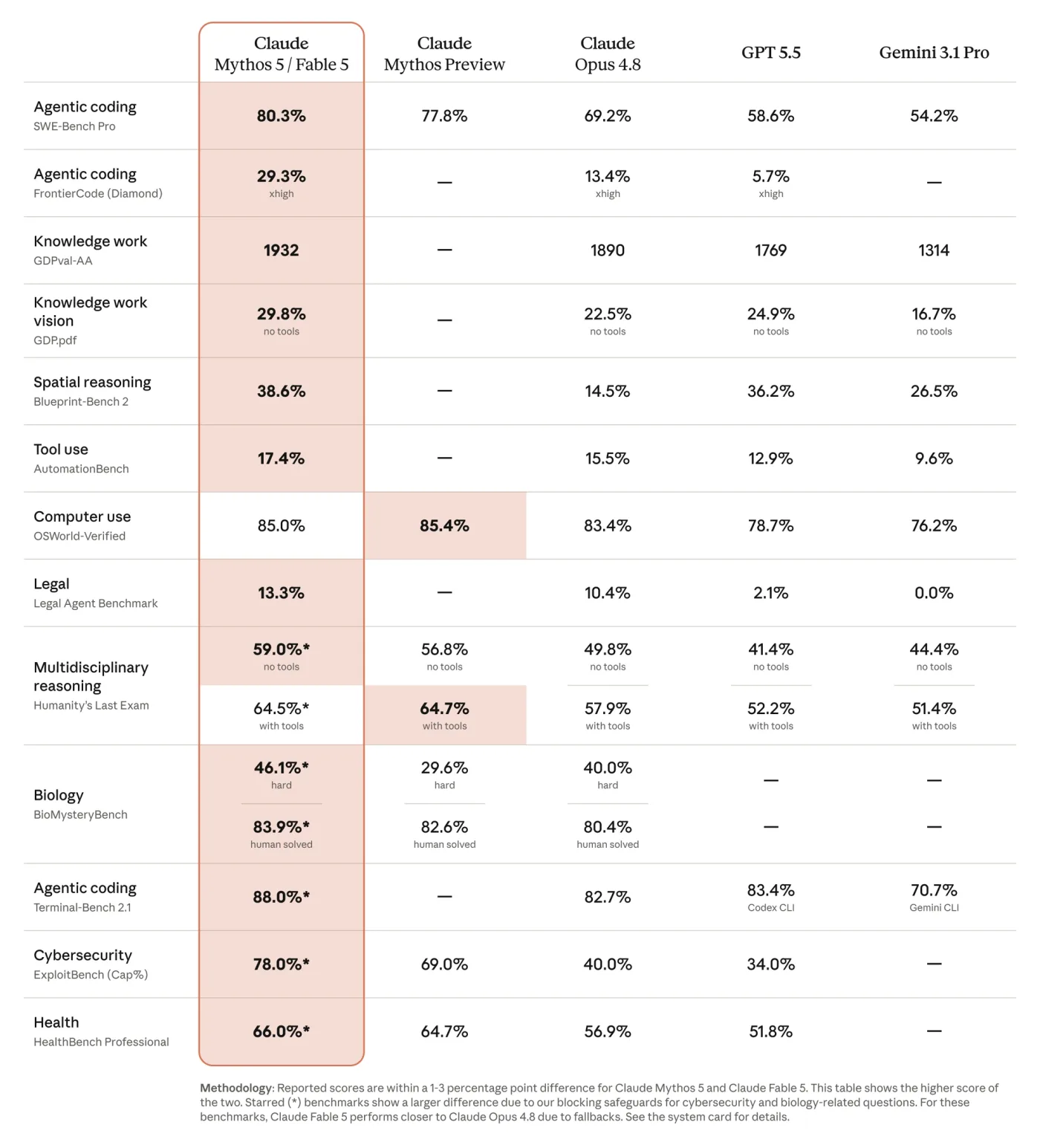
Anthropic’s launch evaluation compares Claude Fable 5 and Claude Mythos 5 with other frontier models. The results below are reported by Anthropic and depend on the stated harness, effort level, tool access, and evaluation methodology. They should be read as evidence about particular tasks, not as a guarantee for every real-world request.

BenchmarkCategoryReported resultWhat it measures
SWE-Bench ProAgentic coding80.3%Measures repository-level software engineering work.
FrontierCode DiamondAgentic coding29.3%Reported at xhigh effort on the hardest coding subset.
GDPval-AAKnowledge work1932Evaluates economically valuable professional tasks.
GDP.pdfKnowledge work vision29.8%Reported without tools for document-based visual reasoning.
OSWorld-VerifiedComputer use85.0%Evaluates interaction with real computer environments.
Terminal-Bench 2.1Agentic coding88.0%Measures terminal-based technical task completion.
Humanity’s Last ExamMultidisciplinary reasoning64.5%Reported with tools; the no-tools result is 59.0%.
HealthBench ProfessionalHealth66.0%A capability evaluation, not a substitute for medical advice.

The table also reports 38.6% on Blueprint-Bench 2 for spatial reasoning, 17.4% on AutomationBench for tool use, and 13.3% on the Legal Agent Benchmark. Some scores have larger variance. A representative evaluation using your own documents, repositories, tools, and acceptance criteria is more useful than selecting a model from one headline result.

Read Anthropic’s methodology
Anthropic benchmark comparison for Claude Fable 5 and other frontier models
Official launch comparison published by Anthropic. Evaluation settings and variance notes apply.

Where the Fable 5 model is most useful

Claude Fable 5 is best reserved for work where stronger reasoning, broad context, or sustained autonomy can justify its higher token price.

Repository-scale coding

Ask the model to map a codebase, identify affected modules, propose a migration plan, implement reviewable stages, run checks, and summarize unresolved risks.

Research across many sources

Provide a focused collection of papers, reports, or internal documents. The model can build an evidence map, compare claims, surface disagreements, and draft conclusions tied to the supplied material.

Financial and operational analysis

Use the model to inspect tables, explain changes, test assumptions, and organize a decision memo. Specify spreadsheet formulas and audit checks, then reconcile generated calculations against source data.

Visual QA and interface reconstruction

Supply screenshots with requirements or existing code. The model can identify layout structure, compare states, reason about missing interactions, and turn a visual reference into an implementation plan.

How to get better results from Claude Fable 5

Define a testable outcome

State what must be delivered, which constraints cannot change, and how the answer will be judged. An acceptance checklist gives the model a target for planning and self-review.

Provide relevant context

Include the files and background needed for the decision, but remove duplicate or unrelated material. Explain the role of each important document.

Ask for a plan before irreversible work

For code changes, data operations, or external actions, review the proposed approach first. Identify approval steps, tool permissions, tests, evidence requirements, and stop conditions.

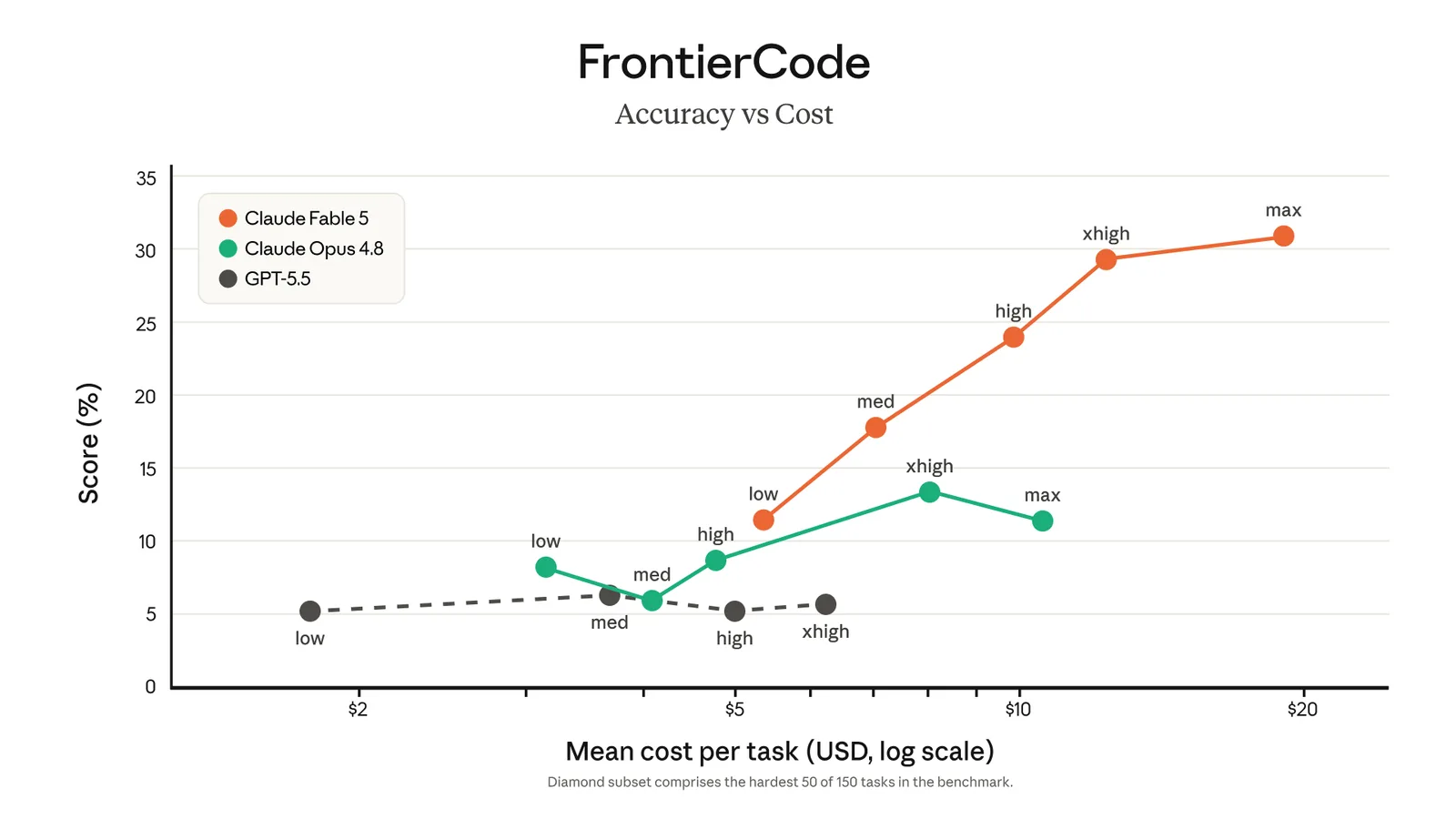
FrontierCode accuracy versus cost chart for Claude Fable 5
Anthropic’s launch chart shows FrontierCode performance across effort levels and mean task cost.

Safeguards, availability, and cost

Fable 5 shares its underlying model with Claude Mythos 5, but Anthropic applies safeguards for general access. Certain covered requests may fall back to Claude Opus 4.8. Anthropic reported that more than 95% of early Fable sessions did not trigger this fallback.

Launch API pricing is $10 per million input tokens and $50 per million output tokens. Long context and high effort can increase task cost, so production systems should set limits, track usage, and route simple requests to a less expensive model.

The model is generally available through the Claude API and supported cloud platforms. Consumer availability may vary by plan, capacity, and usage-credit policy. The CTA on this page opens the official Claude website.

Claude Fable 5 FAQ

When was Claude Fable 5 released?

Anthropic announced the model on June 9, 2026, with general availability through the Claude API and supported cloud platforms.

What is the Claude Fable 5 context window?

The documented context window is one million tokens, with a maximum output of 128,000 tokens. Usable capacity also depends on request structure and platform limits.

Is Claude Fable 5 good for coding?

Anthropic positions it for long-horizon agentic coding. Published results include 80.3% on SWE-Bench Pro and 88.0% on Terminal-Bench 2.1. Real projects still require tests and review.

Can Fable 5 understand images and documents?

Yes. It can reason over images, screenshots, charts, scientific figures, and documents. Readable inputs and specific questions improve results.

How much does the Claude Fable 5 API cost?

Launch pricing is $10 per million input tokens and $50 per million output tokens. Platform charges and cloud-provider pricing may affect the final cost.

What is the difference between Fable 5 and Mythos 5?

They use the same underlying model. Fable 5 adds safeguards for general use, while Mythos 5 is available only through a limited trusted-access program.

Does Claude Fable 5 always answer as Fable 5?

Not necessarily. Safety classifiers can route some requests to Claude Opus 4.8. Anthropic says more than 95% of early sessions did not use that fallback.

Does the model browse the web automatically?

Web access depends on the Claude product or API tools enabled for the session. Verify recent facts and source-sensitive claims.

Should every task use Claude Fable 5?

No. Routine rewriting, classification, and extraction may be faster and cheaper on another model. Fable 5 is most useful when difficulty, duration, or context justifies its cost.

Can I use Claude Fable 5 on this website?

This page is an independent model guide, not a built-in chat. Use the CTA to continue to the official Claude website.

Continue with Claude Fable 5

Open the official Claude website to review current availability, choose an eligible model, and start a conversation with your own instructions and files.

Open AI chat